Key Takeaways
304 (A2) and 316 (A4) are the two most common stainless steel fastener grades — 316 adds molybdenum, which significantly improves corrosion resistance.
316 costs 30-50% more than 304, but in coastal, chemical, or food environments it's the only choice that won't rust in 2-3 years.
A2-70 means 304 stainless, 700 N/mm² tensile strength. A4-80 means 316 stainless, 800 N/mm². The number after the dash is the strength grade, not the material.
Stainless steel bolts can gall (seize) when tightened — always use anti-seize compound or lubrication, especially with 316.
Quick Answer
304 (A2-70) works for most indoor and mild outdoor environments. 316 (A4-80) adds molybdenum for chloride resistance — use it for coastal, chemical, and food-processing environments. 316 costs 30-50% more but lasts 2-3x longer in corrosive settings.
A customer calls: "We need stainless steel bolts for a project near the coast. Is 304 okay, or do we need 316?" This is one of the most common questions I get — and one of the most important to get right, because choosing the wrong one means rusted bolts in two years and a costly re-do.
I've seen 304 bolts on a coastal boardwalk rust through in 18 months. I've also seen 316 bolts on the same boardwalk still shining after 10 years. The difference isn't magic — it's molybdenum, and it's worth understanding when you need it and when you don't.
A food processing plant in the Netherlands installed 304 stainless bolts on a washdown conveyor line because they were cheaper. The daily caustic cleaning solution (pH 11, plus chlorinated water) caused pitting corrosion on 30% of the bolts within 8 months — the pitting trapped food residue and failed the hygiene audit. Replacing all 2,400 bolts with 316 cost €9,600, plus 2 days of production downtime (€15,000). The 304 savings? About €2,100. For any environment with regular chemical cleaning, 316 is the minimum spec.
Why a Food Plant Switched From 304 to 316
A seafood processing plant in Thailand used 304 stainless bolts on their washing line. After 8 months, pitting corrosion appeared — chlorine in the cleaning solution attacked the 304. We switched them to A4-80 (316) bolts with 2.5% molybdenum. After 18 months, zero corrosion. The upfront cost was 35% higher, but they avoided 3 shutdowns for bolt replacement. Our spectrometer checks every heat for molybdenum content — no 304 sold as 316.
What's the Actual Difference?
Both 304 and 316 are austenitic stainless steels — non-magnetic, can't be hardened by heat treatment, and rely on chromium for corrosion resistance. The key difference is one element:
- 304 (A2): 18% chromium, 8% nickel — the classic "18-8" stainless
- 316 (A4): 16-18% chromium, 10-14% nickel, 2-3% molybdenum
That 2-3% molybdenum doesn't sound like much, but it dramatically improves resistance to chloride-induced corrosion (pitting and crevice corrosion). Chloride is what's in saltwater, road salt, bleach, and many industrial chemicals. In a chloride environment, 304 will pit and rust; 316 will hold up far longer.
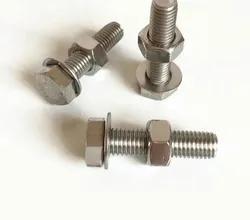
▲ Stainless steel fasteners — A2 (304) and A4 (316) look identical, but their corrosion performance is very different
The A2-70 / A4-80 Code Explained
Stainless steel fasteners are marked with codes like A2-70 or A4-80. Here's how to read them:
- A2 = material group A2 (304 stainless steel)
- A4 = material group A4 (316 stainless steel)
- 70 = minimum tensile strength 700 N/mm² (700 MPa)
- 80 = minimum tensile strength 800 N/mm² (800 MPa)
So A2-70 means 304 stainless, 700 MPa tensile. A4-80 means 316 stainless, 800 MPa tensile. The strength grade (70, 80) is separate from the material grade (A2, A4) — you can get A2-80 (304 at higher strength) or A4-70 (316 at standard strength), though A2-70 and A4-80 are the most common.
For comparison, a carbon steel grade 8.8 bolt has 800 MPa tensile — similar to A4-80. But stainless has much lower yield strength relative to tensile, so don't assume stainless bolts can replace carbon steel in high-load applications without checking the specs.
Where to Use 304 (A2)
304 is the right choice when the environment is dry or mildly corrosive:
- Indoor applications — factories, warehouses, office buildings
- Food processing equipment (304 is FDA-approved for food contact)
- Architectural trim and fasteners in inland areas
- Automotive trim and components (under hood, not under car)
- Medical equipment and instruments
- General outdoor use in low-humidity, low-salt environments
304 is also significantly cheaper — typically 30-50% less than 316 for the same size and grade. If your application isn't exposed to chlorides, 304 is the economical choice.
We stock A2-70 DIN 933 full-thread hex bolts and A2-70 DIN 931 half-thread bolts in sizes M3-M24, with nuts and washers to match.
Where You Must Use 316 (A4)
316 is non-negotiable in these environments:
- Coastal and marine — within 5 km of saltwater, or anywhere with salt spray. Boat hardware, dock hardware, coastal construction.
- Road salt exposure — bridges, parking garages, road barriers in cold climates where salt is used for de-icing.
- Chemical processing — any equipment exposed to chlorides, acids, or caustic solutions. Pulp and paper, pharmaceutical, water treatment.
- Food processing with corrosive cleaning — if the equipment is regularly cleaned with bleach or chlorinated cleaners, 316 holds up better than 304.
- Swimming pools and water parks — chlorine is a chloride, and 304 will pit around pool areas.
- Petrochemical and oil & gas — sour gas and brine environments require 316 or higher.
If you're not sure whether your environment has chlorides, ask: is there salt, bleach, road salt, seawater, or any chemical with "chloride" in the name within 5 km of the installation? If yes, use 316. The cost difference is small compared to the cost of replacing corroded bolts.
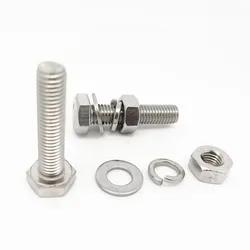
▲ A4-80 (316) stainless fasteners — the molybdenum addition makes them essential for coastal and chemical environments
The Galling Problem — and How to Prevent It
Stainless steel has a unique problem: galling. When two stainless steel surfaces rub together under pressure (like when you tighten a bolt), the material can cold-weld — the threads seize together, and you can't loosen or tighten the bolt. This happens more with 316 than 304, and more with fine threads than coarse threads.
How to prevent galling:
- Always use anti-seize compound — nickel-based or copper-based anti-seize on the threads before assembly. This is the #1 prevention method.
- Slow down — high-speed tightening (impact guns) generates heat and increases galling risk. Use hand tools or slow-speed power tools.
- Use coarse threads — coarse pitch (standard metric) has more clearance than fine pitch, reducing galling.
- Dissimilar metals — using a 304 bolt with a 316 nut reduces galling slightly, though it's not a complete solution.
- Don't over-torque — excessive clamping force increases friction and galling risk. Follow the manufacturer's torque values for stainless.
For more on fastener selection for harsh environments, see our marine fastener comparison guide. And for coating options on carbon steel bolts (which can be a cheaper alternative to stainless in some cases), see our salt spray testing and coating selection guide.
Quick Decision Guide
| Environment | Recommended | Why |
|---|---|---|
| Indoor, dry | 304 (A2-70) | Sufficient corrosion resistance, lowest cost |
| Food processing (dry) | 304 (A2-70) | FDA-approved, easy to clean |
| Outdoor, inland (no salt) | 304 (A2-70) | Good atmospheric corrosion resistance |
| Outdoor, coastal (within 5km) | 316 (A4-80) | Molybdenum resists chloride pitting |
| Road salt / de-icing areas | 316 (A4-80) | Chloride from road salt attacks 304 |
| Chemical / chlorinated | 316 (A4-80) or higher | 316 resists most acids and chlorides |
| Pool / water park | 316 (A4-80) | Chlorine water attacks 304 |
| High load structural | Carbon steel 8.8/10.9 + coating | Stainless has lower yield strength |
Our Stainless Steel Fastener Line
Stainless bolts run on a separate cold heading line — the tooling is different because 304/316 work-harden faster than carbon steel. We use slower heading speeds (45-60 ppm vs 75-120 ppm for carbon steel) and more frequent die changes. The thread rolling dies are also different — polished surface finish to prevent galling, which is the #1 failure mode in stainless fasteners.
We stock A2-70 (304) and A4-80 (316) in all common sizes from M3 to M24. Every batch comes with a mill test report (MTR) showing the chemical composition — 316 must have 2.0-3.0% molybdenum, or it's not 316. We've seen suppliers sell 304 as 316 because the extra molybdenum costs money. Our spectrometer checks every heat before production. If the molybdenum reads 0.5%, the whole heat is rejected. That's why our 316 bolts actually survive coastal environments — and why the cheap ones don't.
FAQ
Q: Is 316 stainless steel magnetic?
A: No — both 304 and 316 are austenitic stainless steels and are essentially non-magnetic in the annealed condition. Cold working (like thread rolling) can make them slightly magnetic, but much less than carbon steel or martensitic stainless (410, 420). If a magnet sticks strongly to a "stainless" bolt, it's probably 410 or 420, not 304 or 316.
Q: Can I use 304 bolts with 316 nuts?
A: Yes, and this combination actually reduces galling slightly because the dissimilar materials are less likely to cold-weld. But here's the catch: the 304 bolt will be the weaker link in a corrosive environment — if the bolt corrodes, the joint fails no matter the nut. For maximum corrosion resistance, use both 316 bolt and 316 nut.
Q: What's the difference between A4-70 and A4-80?
A: Both are 316 stainless steel. A4-70 has 700 MPa minimum tensile strength; A4-80 has 800 MPa. A4-80 is cold-worked more to achieve higher strength, which also makes it slightly more susceptible to galling. For most applications, A4-80 is the standard. A4-70 is used where lower strength is acceptable and galling is a concern.
Q: How long do 316 bolts last in coastal environments?
A: In moderate coastal exposure (not direct seawater immersion), 316 fasteners can last 15-25 years with minimal maintenance. In direct seawater immersion or splash zones, 316 may still experience crevice corrosion in 5-10 years — for these extreme environments, consider super austenitic (254 SMO) or duplex stainless steel, or use hot-dip galvanized carbon steel with regular inspection.
Q: Can stainless steel bolts be used in high-temperature applications?
A: 304 is usable up to about 800°C (continuous), 316 up to about 850°C. But here's the catch: at temperatures above 400-500°C, the strength drops significantly and carbide precipitation (sensitization) can reduce corrosion resistance. For high-temperature applications above 500°C, consult the manufacturer — specialty alloys like Inconel or Hastelloy may be required.
304 or 316 — the choice comes down to one question: is there chloride in the environment? If yes, spend the extra money on 316. If no, 304 will serve you well for decades. And either way, use anti-seize. Your future self will thank you.
Need a reliable custom fastener manufacturer and supplier? Yuanpai manufactures bolts, nuts and washers to your drawings and project specifications, with full material traceability and mill test reports.