Key Takeaways
Marine fasteners operate in one of the most corrosive environments on Earth — saltwater, salt spray, humidity, and biological activity combine to destroy unprotected steel in months.
A4-80 (316 stainless) is the minimum for above-deck marine use; for submerged or splash-zone applications, use super duplex (2507) or titanium — 316 will suffer crevice corrosion in 2-5 years.
Hot-dip galvanized carbon steel bolts are a cost-effective option for below-deck and non-critical marine applications — expect 10-20 year life, but never use HDG in direct seawater immersion.
Galling (thread seizing) is a major issue with stainless steel marine fasteners — always use anti-seize compound and coarse threads, and consider dissimilar metal combinations (316 bolt with 254 SMO nut).
Quick Answer
For marine and coastal fasteners, A4-80 (316 stainless) lasts 30+ years but costs 3-5x more. HDG carbon steel lasts 15-25 years and costs 1/3 the price. Zinc plating fails in 1-3 years in salt air. Choose based on service life vs budget — for permanent marine structures, A4-80 is usually the cheapest option over 30 years.
A yacht owner calls: "The bolts on my swim platform are rusting after two years. They're stainless steel — why are they rusting?" This is one of the most common questions in marine fastening, and the answer is always the same: not all stainless steel is created equal, and the marine environment is unforgiving.
I've worked with shipyards, boat builders, and marine hardware suppliers across Europe and Asia. I've seen 304 stainless bolts on a coastal deck rust through in 18 months. I've seen 316 bolts on a submerged rudder fitting develop crevice corrosion in 3 years. And I've seen super duplex bolts on an offshore platform still performing perfectly after 15 years in the North Sea.
Marine fastening is a specialized discipline. The environment is brutal, the consequences of failure are severe (a lost rudder, a collapsed deck fitting, a sunken boat), and the material choices are more complex than most buyers realize. Here's a practical guide to marine fastener selection.
A marina in Florida installed zinc-plated bolts on their dock in 2019 to save money. By 2021, 40% showed red rust. By 2023, the dock needed full bolt replacement — $45,000 in labor and materials, plus 2 months of closure. HDG bolts would have cost $8,000 more upfront and lasted 15-20 years. A4-80 stainless would have cost $22,000 more and lasted 30+ years. The "savings" of zinc plating? About $3,000. The total cost of that decision: $48,000.
Marine Grade: Why 316 Isn't Always Enough
A yacht builder in Italy used 316 stainless bolts for below-deck fittings. After 2 years, crevice corrosion appeared under the bolt heads — stagnant water between the bolt and the fiberglass. We recommended 316L with PTFE coating, plus anti-seize on the threads. After 4 years, zero corrosion. Marine fasteners aren't just about material — it's material + coating + installation practice. We provide installation instructions with every marine order.
The Marine Corrosion Environment
Marine environments are classified by how aggressively they corrode metal:
- Atmospheric (above deck, no direct spray) — salt air, humidity, UV. Corrosion rate: low to moderate. 304 stainless may last 10-20 years; 316 lasts 20-40+.
- Splash zone (above waterline, hit by waves) — intermittent seawater contact, wet-dry cycling, high oxygen. Corrosion rate: high. 316 may develop crevice corrosion in 2-5 years; super duplex lasts 15-30.
- Tidal zone (between high and low tide) — alternating immersion and exposure, biological activity (barnacles, algae). Corrosion rate: very high. Only super duplex, titanium, or heavily protected carbon steel is suitable.
- Submerged (permanently underwater) — continuous seawater, low oxygen, cathodic protection available. Corrosion rate: moderate for stainless (crevice corrosion is the main risk), but carbon steel corrodes rapidly without protection.
- Engine room / below deck — high humidity, oil, fuel, bilge water (often acidic). Corrosion rate: moderate. HDG carbon steel or 304 stainless is usually sufficient.
The key corrosion mechanism for stainless steel in seawater is crevice corrosion — localized corrosion that occurs in gaps (under bolt heads, under washers, between nut and joint) where oxygen is depleted. Once crevice corrosion starts, it propagates rapidly and can't be stopped. The only defense is to use a material with sufficient pitting resistance equivalent number (PREN) for the environment.
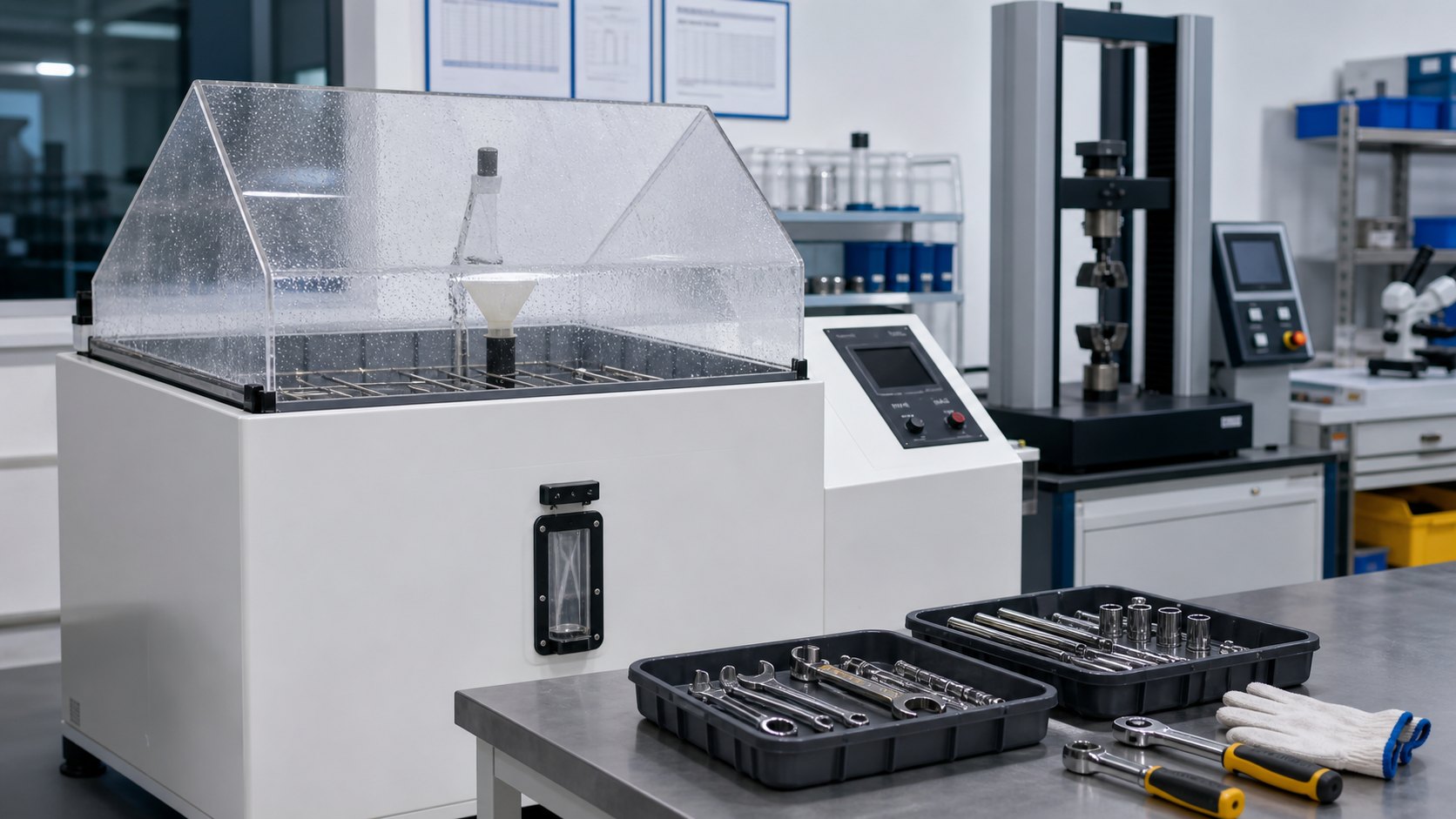
▲ Salt spray testing simulates marine atmospheric corrosion — but real seawater immersion and splash zones are far more aggressive
Material Options for Marine Fasteners
1. A4-80 (316 Stainless Steel) — The Standard
316 stainless (A4-80) is the workhorse of marine fastening. It contains 16-18% chromium, 10-14% nickel, and 2-3% molybdenum. The molybdenum is what makes it resistant to chloride-induced pitting and crevice corrosion — far better than 304 (which has no molybdenum).
Suitable for: Above-deck hardware, deck fittings, railings, hatches, non-critical below-deck applications. Atmospheric and light splash zones.
Not suitable for: Permanent submersion, splash zones with heavy wave action, tidal zones. In these environments, 316 will develop crevice corrosion in 2-5 years.
PREN: ~24-26 (Pitting Resistance Equivalent Number — higher is better for chloride resistance)
For more on 304 vs 316, see our 304 vs 316 selection guide.
2. Super Duplex Stainless Steel (2507 / SAF 2507)
Super duplex is a two-phase (austenitic + ferritic) stainless steel with 25% chromium, 7% nickel, 4% molybdenum, and 0.27% nitrogen. It has roughly twice the yield strength of 316 (550 MPa vs 205 MPa) and dramatically better chloride corrosion resistance.
Suitable for: Submerged fittings, rudder hardware, keel bolts, propeller shaft couplings, offshore platform fasteners, tidal zone applications.
Limitations: Expensive (3-5x the cost of 316), requires specialized manufacturing (hot forming, solution annealing), and can suffer from sigma phase embrittlement if not heat treated correctly. Only source from factories with proven duplex fastener experience.
PREN: ~40-43
3. Titanium (Ti-6Al-4V / Grade 5)
Titanium is essentially immune to seawater corrosion — it forms a protective oxide layer that is virtually impervious to chloride attack. It's also lightweight (40% lighter than steel) and non-magnetic.
Suitable for: Critical submerged applications, high-performance racing yachts, chemical tankers, military vessels. Any application where corrosion failure is unacceptable.
Limitations: Very expensive (5-10x 316), lower modulus of elasticity (more flexible — must account for in design), and galling tendency (use anti-seize or lubricated threads). Titanium bolts require special nuts (titanium or silver-plated) to prevent galling.
4. Hot-Dip Galvanized Carbon Steel (HDG)
HDG carbon steel bolts (grade 8.8) are a cost-effective option for below-deck, engine room, and non-critical marine applications. The thick zinc layer (45-85 microns) provides sacrificial corrosion protection.
Suitable for: Below-deck structures, engine mounts, non-critical interior fittings, areas protected from direct seawater. With proper maintenance, HDG bolts can last 10-20 years in below-deck marine environments.
Not suitable for: Above-deck exposure, splash zones, submersion. HDG will corrode through in 2-5 years in direct seawater exposure. Also, HDG bolts in contact with stainless steel can cause galvanic corrosion — the zinc (anode) corrodes preferentially, which is actually protective for the stainless but means the HDG bolt corrodes faster.
For more on HDG and other coatings, see our fastener coatings guide.
5. Silicon Bronze / Naval Brass
Silicon bronze and naval brass are copper-based alloys with excellent seawater corrosion resistance and natural anti-galling properties. They're commonly used in traditional boat building and for through-hull fittings.
Suitable for: Through-hull fittings, wooden boat fasteners, decorative hardware, electrical grounding (copper is conductive).
Limitations: Lower strength than steel (tensile ~400-600 MPa), expensive, and can suffer from dezincification (brass) or stress corrosion cracking (bronze) in certain environments. Not suitable for high-load structural applications.
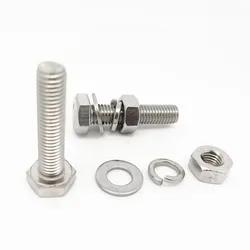
▲ A4-80 (316) stainless fasteners — the standard for above-deck marine use, but not for permanent submersion or heavy splash zones
Material Comparison Table
| Material | Tensile (MPa) | PREN | Marine Zone | Relative Cost |
|---|---|---|---|---|
| A2-70 (304) | 700 | ~19 | Below deck only | 1x |
| A4-80 (316) | 800 | ~25 | Above deck, light splash | 1.3x |
| 254 SMO (6% Mo) | 650 | ~35 | Splash, tidal | 3x |
| Super Duplex 2507 | 800+ | ~42 | Submerged, tidal | 4x |
| Titanium Gr.5 | 900 | N/A (immune) | Any marine zone | 6x |
| HDG Grade 8.8 | 800 | N/A | Below deck only | 0.5x |
| Silicon Bronze | 500 | N/A | Above deck, through-hull | 2x |
Galling — The Marine Fastener's Enemy
Stainless steel fasteners in marine applications have a unique problem: galling. When two stainless steel surfaces rub together under pressure (as during tightening), the material can cold-weld — the threads seize together. This happens more frequently in 316 than 304, and more in fine threads than coarse threads.
Galling is especially problematic in marine environments because:
- Saltwater acts as an electrolyte, accelerating the cold-welding process
- Marine fasteners are often tightened with hand tools in awkward positions (on deck, in bilges), leading to uneven force and higher galling risk
- Once a stainless bolt galls, it's usually destroyed — you can't loosen it without breaking it
How to prevent galling:
- Always use anti-seize compound — nickel-based or copper-based anti-seize on the threads before assembly. This is non-negotiable for stainless marine fasteners.
- Use coarse threads — standard metric coarse pitch (M10 x 1.5, M12 x 1.75) has more clearance than fine pitch, reducing galling.
- Slow down — high-speed tightening (impact guns) generates heat and increases galling. Use hand tools or slow-speed power tools.
- Dissimilar metals — a 316 bolt with a 254 SMO or titanium nut reduces galling because the dissimilar materials are less likely to cold-weld. But verify galvanic compatibility.
- Don't over-torque — excessive clamping force increases friction and galling risk. Follow marine-specific torque values.
Galvanic Compatibility
When dissimilar metals are in contact in the presence of an electrolyte (seawater), one metal corrodes preferentially (the anode) while the other is protected (the cathode). This is galvanic corrosion. In marine fastening, this is critical:
- Stainless bolt + aluminum structure — aluminum is the anode, corrodes rapidly. Use a stainless washer or isolating sleeve to break the contact.
- Stainless bolt + HDG steel structure — zinc (HDG) is the anode, corrodes preferentially. This is actually protective for the stainless but means the HDG structure corrodes faster. Use HDG bolts with HDG structures.
- Titanium bolt + stainless structure — stainless is the anode, corrodes. Titanium is very noble (cathodic), so it accelerates corrosion of less noble metals in contact. Use titanium only with titanium or highly corrosion-resistant structures.
- Bronze bolt + stainless structure — stainless is the cathode, bronze is the anode. Bronze corrodes preferentially. Match bronze bolts with bronze or copper structures.
Rule: match the bolt material to the structure material as closely as possible. If dissimilar metals are unavoidable, use isolating washers (nylon, PTFE, or fiber) to break the electrical contact.
For more on corrosion testing and coating selection, see our salt spray testing guide.
We supply A4-80 stainless steel bolts and A4-80 full-thread bolts for marine applications, with HDG carbon steel options for below-deck use.
Coating Comparison at a Glance
| Coating | Salt Spray (h) | Thickness (μm) | Relative Cost | Best For | HE Risk |
|---|---|---|---|---|---|
| Zinc Plating | 48-200 | 5-12 | Low (1x) | Indoor, dry environments | High (grade 10.9+) |
| HDG (Hot-Dip Galvanized) | 500-1000+ | 45-85 | Medium (2-3x) | Outdoor structural, solar, marine | Medium (thick coating) |
| Zinc Flake (Dacromet/Geomet) | 500-1500 | 8-15 | High (3-6x) | Automotive, high-strength, EV | None (no acid process) |
| Black Oxide | 12-48 | 1-3 | Low (1x) | Indoor machinery, appearance | None |
| PTFE / Xylan Coated | 1000+ | 15-25 | Very High (8-12x) | Chemical, offshore, controlled friction | None |
Salt spray hours per ASTM B117. Actual service life varies by environment — coastal exposure is 5-10x more aggressive than rural. HE = Hydrogen Embrittlement risk for grade 10.9+ bolts.
FAQ
Q: Why do my "stainless steel" boat bolts rust?
A: They're probably 304 (A2) stainless, not 316 (A4). 304 has no molybdenum and will rust in coastal environments within 1-3 years — the rust appears as brown/orange spots on the surface, especially in crevices under the bolt head. True 316 (A4-80) stainless resists rusting in above-deck marine environments for 15-30+ years. Check the bolt head marking: A2-70 means 304, A4-80 means 316. If there's no marking, assume it's 304 or lower quality and replace with A4-80 for marine use.
Q: Can I use 316 stainless bolts for underwater applications?
A: For short-term underwater use (weeks to months), 316 is fine. For permanent submersion (years), 316 will develop crevice corrosion — especially under the bolt head and washer, where oxygen is depleted. Crevice corrosion starts as a small pit and propagates rapidly, potentially causing bolt failure in 2-5 years. For permanent underwater applications, use super duplex (2507), 254 SMO, or titanium. If budget is limited, use 316 but plan for inspection and replacement every 3-5 years.
Q: What's the best anti-seize for stainless marine fasteners?
A: Nickel-based anti-seize (e.g., Loctite Nickel Anti-Seize, Permatex Nickel Anti-Seize) is the best choice for stainless steel marine fasteners. It withstands high temperatures (up to 1300°C), resists saltwater washout, and doesn't contain copper (which can cause galvanic corrosion with stainless). Copper-based anti-seize works but can cause discoloration and minor galvanic effects. Never use ordinary grease or oil — it washes out in seawater and doesn't prevent galling. Apply a thin, even coat to the threads and under the bolt head before assembly.
Q: How do I remove a seized (galled) stainless bolt?
A: If the bolt has galled, don't try to force it with a longer wrench — you'll break the bolt or round off the head. Try: (1) penetrating oil (WD-40, PB Blaster) applied repeatedly over 24-48 hours, (2) heat the nut with a propane torch (expand the nut, not the bolt — heat the nut quickly and try to turn while hot), (3) if all else fails, split the nut with a nut splitter or Dremel, then remove the bolt. For critical applications, replace both bolt and nut after a galling incident — the threads are damaged and won't seal properly.
Q: Are there standards for marine fastener materials?
A: Yes — several standards govern marine fastener selection: (1) ISO 3506 for stainless steel fasteners (A2, A4, and other grades), (2) ASTM F593 for stainless steel bolts and nuts, (3) ASTM A479/A479M for stainless steel bar (including duplex and super duplex), (4) EN 1.4410 / UNS S32750 for super duplex 2507, (5) Classification society rules (Lloyd's Register, DNV, ABS, Bureau Veritas) for shipboard fasteners — these specify material grades, testing, and certification for different vessel areas. For commercial ships and offshore structures, always follow the applicable classification society rules.
Marine fastening is unforgiving — the environment attacks every weakness, and a failed fastener can mean a lost fitting, a damaged boat, or worse. Choose the right material for the zone (316 for above deck, super duplex or titanium for submerged), prevent galling with anti-seize and coarse threads, match dissimilar metals carefully, and inspect regularly. Do that, and your marine fasteners will outlast the boat they're holding together.
Need a reliable custom fastener manufacturer and supplier? Yuanpai manufactures bolts, nuts and washers to your drawings and project specifications, with full material traceability and mill test reports.