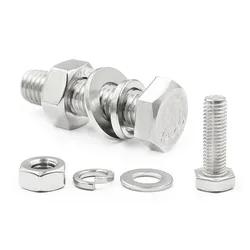
Key Takeaways
DIN 931 is a hex bolt with partial (half) thread — the unthreaded shank provides shear strength and proper clamp force. DIN 933 is fully threaded to the underside of the head.
DIN 931 is the correct choice for structural and clamped joints — the smooth shank centers the bolt and the thread doesn't bear on the shear plane. DIN 933 is for tapped holes and thin joints.
Using DIN 933 (full thread) where DIN 931 (half thread) is specified reduces shear strength by 10-20% because the thread root acts as a stress concentration in the shear plane.
DIN 931 and ISO 4014 are functionally identical; DIN 933 and ISO 4017 are functionally identical — the standards were harmonized in the 1990s.
Quick Answer
DIN 931 (half thread) is for structural joints where the smooth shank must sit in the shear plane. DIN 933 (full thread) is for tapped holes and thin joints. Using DIN 933 in a structural joint reduces shear strength by 15-22%.
"We need M16 x 80mm hex bolts." That's what the buyer says. But which one? DIN 931 or DIN 933? They look almost identical in the catalog. The prices are similar. Does it really matter?
It matters — more than most buyers realize. DIN 931 (half thread) and DIN 933 (full thread) are designed for fundamentally different applications. Using the wrong one can reduce joint strength, cause improper clamp force, and lead to premature failure. I've seen structural connections where DIN 933 full-thread bolts were used instead of DIN 931, and the bolts failed in shear at loads well below the design capacity — because the thread root was sitting in the shear plane.
After years of specifying and supplying both standards, here's the technical deep dive on DIN 931 vs DIN 933 — what the differences are, why they matter, and how to choose the right one.
A construction firm in the UAE once ordered M20 x 100mm DIN 933 full-thread bolts for a steel canopy structure because they were 3% cheaper than DIN 931. During load testing, three bolts failed in shear at 78% of design load — the thread root was sitting in the shear plane, reducing the effective shear area from 314 mm² to 245 mm². The entire batch had to be replaced with DIN 931 half-thread bolts, delaying the project by 10 days and costing AED 85,000 in rework. The 3% savings? About AED 1,200.
DIN 931 vs DIN 933: The Thread That Failed
A structural engineer in the UAE specified "M20 hex bolts" for a steel frame. The supplier shipped DIN 933 (full thread). In a moment connection, the smooth shank should sit in the shear plane — full thread means the thread root (the weakest point) is in the shear plane. The bolts failed at 78% of design load during testing. We supplied DIN 931 (half thread) with the correct smooth shank length. They passed. We always confirm thread type before production — it's not a detail, it's a safety issue.
The Core Difference: Thread Length
Both DIN 931 and DIN 933 are hexagon head bolts with the same head dimensions, the same wrench sizes, and the same material grades. The only difference is the thread length:
- DIN 931 — Hexagon head bolt with partial thread (also called "half thread" or "shank bolt"). The bolt has a smooth, unthreaded shank below the head, with threads only on the end portion. The thread length is specified in the standard: for bolts up to 125mm long, thread length = 2d + 6mm (where d = nominal diameter). For 125-200mm, thread = 2d + 12mm. For over 200mm, thread = 2d + 25mm.
- DIN 933 — Hexagon head bolt with full thread. The threads run all the way to the underside of the head, with no smooth shank (or a very short unthreaded portion under the head, typically 1-2mm).
Example: M16 x 80mm bolt
- DIN 931: 80mm total length, 38mm thread (2×16 + 6 = 38mm), 42mm smooth shank
- DIN 933: 80mm total length, ~78mm thread (full thread to within 2mm of the head)
This seems like a minor difference — but it has major implications for joint performance.
▲ DIN 933 (full thread, left) vs DIN 931 (half thread with smooth shank, right) — the smooth shank is the key difference for structural joints
Why DIN 931 (Half Thread) Is for Structural Joints
In a typical structural joint — two steel plates clamped together with a bolt and nut — the bolt performs two functions:
- Clamping — the bolt is stretched (preloaded) to clamp the plates together, creating friction that resists shear and movement.
- Shear bearing — if the friction is overcome, the bolt shank bears against the sides of the holes, transferring shear load directly.
For both functions, DIN 931 (half thread) is the correct choice:
Clamp Force
The smooth shank of a DIN 931 bolt allows the bolt to stretch elastically when tightened, creating consistent clamp force. The thread portion is less elastic (the thread root reduces the effective cross-sectional area), so a fully threaded bolt (DIN 933) stretches less for the same torque, resulting in lower and less consistent clamp force.
Shear Strength
In a shear joint, the load is transferred through the bolt shank at the interface between the two plates (the shear plane). If the shear plane falls on the threaded portion (as it would with a DIN 933 bolt in a thick joint), the effective shear area is reduced by the thread root — typically by 15-20% compared to the smooth shank. This means the bolt can fail in shear at 80-85% of its rated capacity.
With DIN 931, the smooth shank is positioned in the shear plane (assuming correct bolt length selection), providing full shear strength. This is why structural standards (Eurocode 3, AISC, GB 50017) specify half-thread bolts (DIN 931 / ISO 4014 / A325) for structural connections.
Bolt Centering
The smooth shank of DIN 931 centers the bolt in the hole, ensuring even contact and proper alignment. A fully threaded bolt (DIN 933) can sit off-center in the hole, leading to uneven load distribution and potential bearing failure.
Why DIN 933 (Full Thread) Is for Tapped Holes and Thin Joints
DIN 933 full-thread bolts are designed for applications where the bolt threads directly into a tapped (threaded) hole, rather than passing through clearance holes and receiving a nut:
- Tapped holes — when the bolt screws into a threaded hole in a machine component, engine block, or housing, the full thread ensures maximum thread engagement no matter how deep the tapped hole is.
- Thin joints — when the total clamped thickness is less than the thread length of a DIN 931 bolt, the nut would tighten on the thread runout (the transition between smooth shank and thread), causing improper seating. DIN 933 avoids this by having thread along the entire length.
- Adjustable connections — full thread allows the nut to be positioned at any point along the bolt, useful for adjustable mounts, leveling feet, and tensioning applications.
- Blind holes — when the bolt goes into a blind tapped hole (no through-hole), full thread ensures the bolt can be tightened to the bottom of the hole without bottoming out on a smooth shank.
Common DIN 933 applications: machinery assembly, engine components, furniture, electronic enclosures, automotive interior, pipe flanges (where the bolt threads into a tapped flange), and general-purpose fastening where a nut isn't used.
When to Use Which — Quick Decision Guide
| Application | DIN 931 (Half Thread) | DIN 933 (Full Thread) |
|---|---|---|
| Structural steel connections | ✓ Required | ✗ Not recommended |
| Bolt + nut through clearance holes | ✓ Preferred | △ Acceptable for thin joints |
| Tapped hole (no nut) | ✗ Thread may not reach | ✓ Required |
| Thin joint (< 2d thickness) | △ Nut may seat on runout | ✓ Preferred |
| Adjustable / leveling mounts | ✗ Limited adjustment | ✓ Required |
| High-load shear joints | ✓ Required (smooth shank in shear) | ✗ Reduced shear strength |
| General purpose / hardware | ✓ Good | ✓ Good (more versatile) |
| Automotive chassis / suspension | ✓ Preferred | △ Only where specified |
The Shear Strength Difference — By the Numbers
Let's quantify the shear strength difference for an M16 grade 8.8 bolt:
- M16 nominal diameter: 16mm, cross-sectional area = 201 mm²
- M16 thread stress area (tensile stress area, ISO 898-1): 157 mm²
- Shear area (smooth shank, DIN 931): ~201 mm² (full diameter)
- Shear area (threaded, DIN 933): ~157-167 mm² (depends on whether shear plane is at thread root or pitch diameter)
- Shear strength reduction: (201 - 157) / 201 = 22% reduction if shear plane is at thread root
That's a 22% reduction in shear capacity — significant for a structural joint. If the design assumed the full smooth-shank shear strength, the joint would fail at 78% of the design load. This is why structural codes mandate half-thread bolts and require the smooth shank to be positioned in the shear plane.
For tensile loading, the difference is smaller — both DIN 931 and DIN 933 have the same tensile stress area (157 mm² for M16), because tensile failure always occurs at the thread root no matter where the thread is located. The tensile strength is identical for both standards.
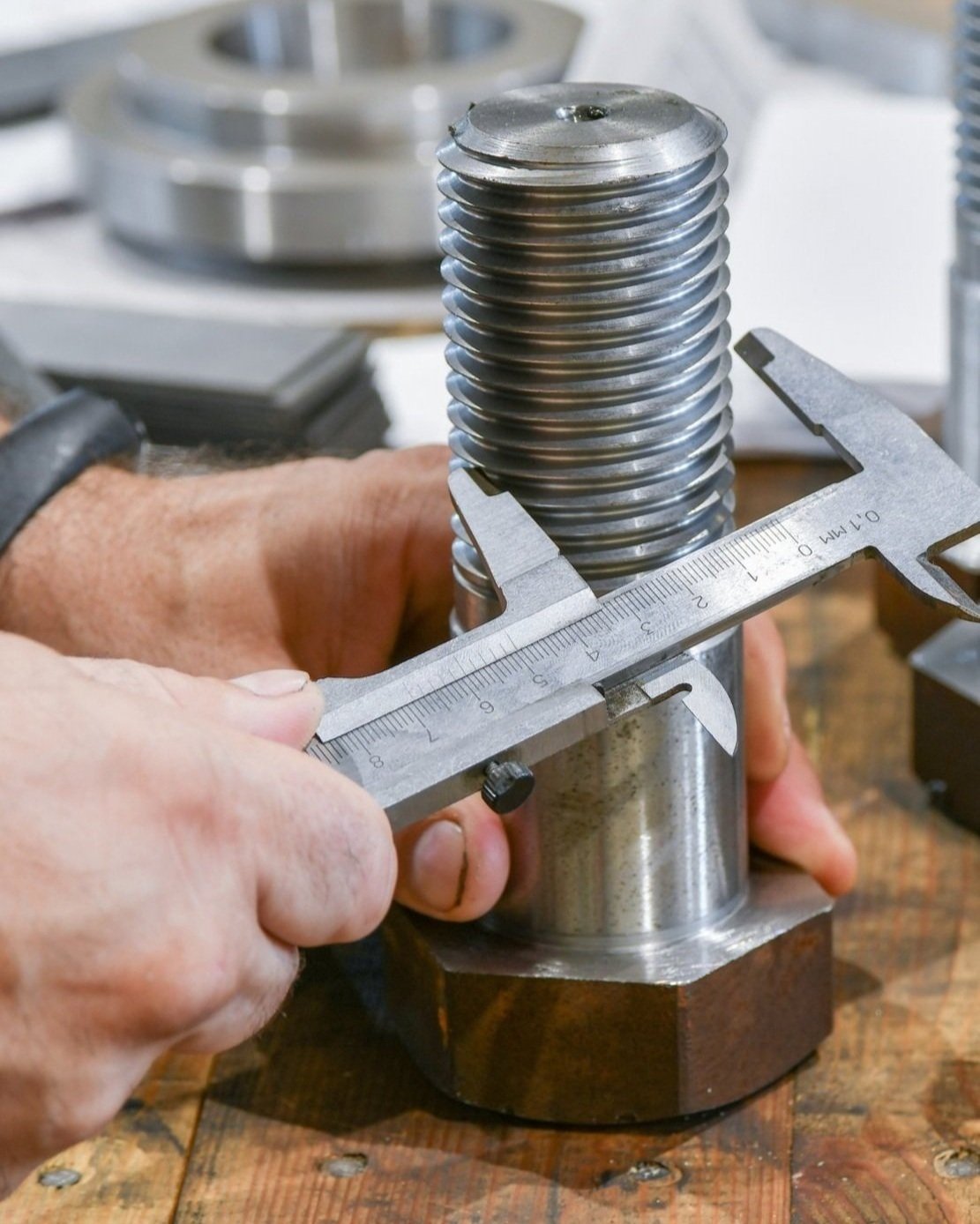
▲ Measuring thread length and shank diameter — verifying that the smooth shank is long enough to span the joint thickness is critical for structural applications
DIN 931 / DIN 933 vs ISO 4014 / ISO 4017
Many buyers ask: "What's the difference between DIN 931 and ISO 4014?" Or "DIN 933 vs ISO 4017?"
The answer: functionally, there is no difference. In the 1990s, ISO harmonized the DIN hex bolt standards into international standards:
- DIN 931 → ISO 4014 (hexagon head bolt, partial thread) — identical dimensions, tolerances, and material requirements
- DIN 933 → ISO 4017 (hexagon head bolt, full thread) — identical dimensions, tolerances, and material requirements
The DIN standards were technically withdrawn in favor of the ISO standards, but the DIN numbers are still widely used in catalogs, purchase orders, and engineering drawings — especially in German-speaking countries and in industries with long-standing DIN traditions (automotive, machinery, construction).
When you order "DIN 931," most suppliers will ship ISO 4014 bolts (which are identical). When you order "DIN 933," you'll get ISO 4017. The packaging may say either standard — they're interchangeable.
For more on standard families, see our DIN/ISO/GB/ANSI buyer checklist and ANSI vs DIN sourcing guide.
Length Selection — Getting the Smooth Shank in the Right Place
For DIN 931 half-thread bolts, selecting the correct length is critical. The goal is to have the smooth shank span the full thickness of the clamped joint, with the thread starting just after the joint. This ensures:
- The smooth shank is in the shear plane (full shear strength)
- The nut tightens on the threaded portion (not on the smooth shank or thread runout)
- There are 1-2 threads protruding beyond the nut (for proper thread engagement and visual inspection)
Formula for selecting DIN 931 bolt length:
Bolt Length = Joint Thickness + Washer Thickness + Nut Height + 2-3 Thread Pitches
Example: M16, 20mm joint + 3mm washer + 14.8mm nut + 4mm (2 pitches) = 41.8mm → use M16 x 45mm DIN 931
If the calculated length falls between standard lengths, round up to the next standard length. Standard lengths per DIN/ISO: 30, 35, 40, 45, 50, 55, 60, 65, 70, 75, 80, 90, 100, 110, 120, 130, 140, 150, 160, 180, 200mm (and larger in 20mm increments).
We supply DIN 931 half-thread hex bolts and DIN 933 full-thread hex bolts in grades 4.8, 8.8, 10.9, and A2-70/A4-80 stainless, sizes M6-M36, with zinc plating, HDG, or zinc flake coating.
How We Inspect Thread Engagement Before Shipping
Every batch of DIN 931 half-thread bolts goes through a thread ring gauge check before packaging. The operator takes 3 pieces per 500 and screws a GO gauge onto the thread — it should turn by hand with no play. Then a NO-GO gauge — it should not enter more than two turns. If either fails, the entire batch is 100% sorted. Last month, a batch of M16 x 80mm DIN 931 failed because the thread rolling die was worn 0.03mm beyond tolerance. We caught it before shipping. The customer never knew — but that's the point.
The smooth shank length is equally critical. For a DIN 931 M20 x 100mm, the thread length is 46mm per standard, leaving 54mm of smooth shank. If a supplier gives you full thread instead, the thread root sits in the shear plane and your joint fails at 78% of design load. We measure shank length with a digital caliper on every first article, and keep the measurement record with the batch paperwork.
FAQ
Q: Can I substitute DIN 933 for DIN 931 if DIN 931 isn't available?
A: For non-critical, low-load applications (furniture, signage, light machinery), DIN 933 can substitute for DIN 931 — the joint will still work, though clamp force may be slightly lower. For structural, high-load, or safety-critical applications, NO — do not substitute. The reduced shear strength (15-22% lower if the thread is in the shear plane) and reduced clamp force can lead to joint failure. If DIN 931 is temporarily unavailable, either wait for stock, use a larger diameter DIN 933 to compensate for reduced shear area, or use a custom-length DIN 931 from a supplier with cutting capability (we can cut and re-thread DIN 931 to custom lengths).
Q: Why are DIN 933 bolts sometimes cheaper than DIN 931?
A: DIN 933 full-thread bolts are simpler to manufacture — the entire shank is threaded, so there's no need to control the thread runout position or the smooth shank diameter as precisely. DIN 931 requires more precise control of the thread length and the transition between smooth shank and thread. In high-volume production, this difference is small (typically 2-5% price difference), but for small batches or non-standard lengths, DIN 933 can be significantly cheaper because the tooling setup is simpler. For standard sizes and grades, the prices are nearly identical.
Q: What about DIN 601 and DIN 603 (carriage bolts)?
A: DIN 601 is a hex head bolt with a smaller head (similar to DIN 931 but with reduced head dimensions) — rarely used today, mostly in older machinery. DIN 603 is a carriage bolt (round head with square neck) — used for wood and thin sheet metal where the square neck prevents rotation. Neither is a substitute for DIN 931/933 in structural applications. If your drawing specifies DIN 601, verify whether DIN 931 can be substituted (usually yes if the head clearance allows). For DIN 603 carriage bolts, they're a different fastener type entirely and can't be substituted with hex bolts.
Q: How do I identify DIN 931 vs DIN 933 if the packaging is missing?
A: Look at the bolt: DIN 931 has a visible smooth shank between the head and the start of the thread. DIN 933 has threads running almost to the underside of the head (typically 1-2mm of smooth shank under the head, then full thread). For short bolts (under 40mm), the difference can be subtle — measure the thread length with a caliper. For an M10 x 30mm bolt: DIN 931 has 26mm thread (2×10+6), leaving 4mm smooth shank; DIN 933 has ~28mm thread. The head marking (grade) is the same for both — only the thread length differs.
Q: Are there other hex bolt standards I should know about?
A: Yes — several: DIN 960 (hex head bolt with fine pitch thread, half thread), DIN 961 (hex head bolt with fine pitch thread, full thread), DIN 6914 (high-strength structural hex bolt, grade 10.9, larger head), ISO 4015 (hex head bolt with fine pitch, half thread), ISO 4016 (hex head bolt with fine pitch, full thread), ASTM A325/A490 (US structural bolts, inch sizes, different head dimensions). For metric general-purpose fastening, DIN 931/ISO 4014 and DIN 933/ISO 4017 are the standards you'll encounter 95% of the time. For structural steel, use DIN 6914 or ASTM A325/A490 — not DIN 931, which isn't certified for structural use (though it's mechanically similar).
DIN 931 and DIN 933 look like the same bolt with a minor thread difference — but that difference determines whether the joint performs as designed or fails prematurely. Use DIN 931 (half thread) for structural and clamped joints where the smooth shank matters. Use DIN 933 (full thread) for tapped holes, thin joints, and adjustable connections. Choose the right length so the smooth shank spans the joint. Do that, and your bolted connections will perform as designed — every time.
Need a reliable custom fastener manufacturer and supplier? Yuanpai manufactures bolts, nuts and washers to your drawings and project specifications, with full material traceability and mill test reports.